



South Carolina Introduction to Computer Programming
- Level High School
- Contact Hours 120
- Timeframe Year
This course is designed to emphasize the fundamentals of computer programming using Python. Topics include computer software, program design and development, and practical experience in programming. This course is fully aligned with the South Carolina Introduction to Computer Programming CTE course.
To view the entire syllabus, click here or click to explore the full course.
MODULES - 11
Students learn about Internet etiquette and how to stay safe online. Students also look at the potential effects of our digital footprints, how to protect information from online risks, and the implications of cyberbullying. The module also includes how to find and cite quality resources online.
Students will compare and contrast common operating systems (Windows, Linux, OS) and explain the importance of application security. They will investigate security options and implement user accounts to enforce authentication and authorization. Students will also demonstrate how to work with basic and advanced command prompts.
Students learn the basics of programming by giving Karel the Dog commands in a grid world.
Students learn the basics of programming by writing programs that interact with users through the keyboard.
Students write a program that allows users to create their own Mad Lib stories using variables and user input.
Students teach their programs to make decisions based on the information it receives.
Students learn how to write more efficient code by using loops as shortcuts.
Students learn how their programs can be decomposed into smaller pieces that work together to solve a problem.
Students learn the theory and practice of user interface design. They will create a program that will quiz users on a series of multiple-choice questions and check their answers. This project allows students to think creatively about the applications of the concepts covered in the course, and create something of personal value.
Students will learn about the role of a data scientist and the iterative steps in the data science life cycle. They will learn and apply the process of the data science life cycle. This includes asking statistical questions, collecting or obtaining reliable data, analyzing the data, and summarizing the results.
Students learn basic safety inside the classroom and how this applies to the workplace. They also explore future career options and the skills needed to obtain these jobs.
Explore programs that your students will build throughout this course!
| Standards Framework | Alignment |
|---|---|
| South Carolina Introduction to Computer Programming | 100% View |
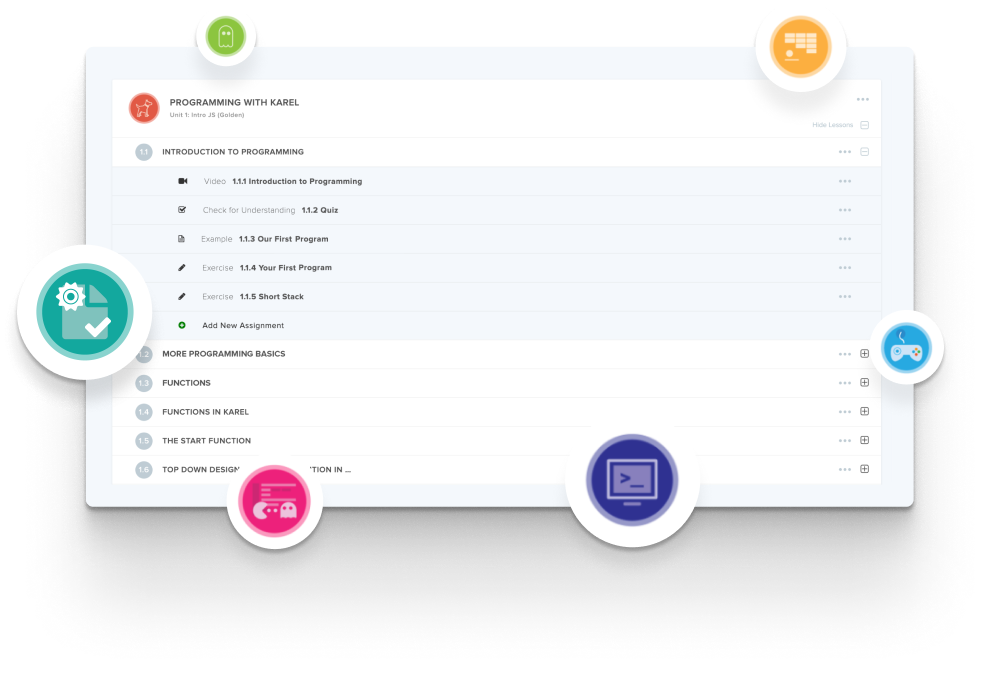
Create and organize Assignments in any CodeHS course that you're teaching. You can even add custom assignments to pre-existing CodeHS courses.
Learn MoreDidn't find what you were looking for? Here are a few links that might be useful to you.
You also might like
Which python course should I use? Click here
It aligns to 100% of the South Carolina Introduction to Computer Programming standards. The CodeHS standards page shows each standard alongside the lesson that covers it, which is what districts usually need for CTE course documentation.
No. The course emphasises the fundamentals of computer programming and assumes no background. It covers computer software, program design and development, and gives students practical experience writing programs.
Students program in Python throughout the course.
The course is built for about 120 contact hours across a full school year.
They cover the same material and both run about 120 hours in Python. They exist separately because South Carolina lists them as two CTE courses, and each CodeHS course aligns to 100% of its own framework. Pick the one matching the CTE course code you are teaching.