



New Jersey Computer Science and Design Thinking
- Level High School
- Contact Hours 130
- Timeframe Year
This course teaches the foundations of computer science and basic programming, with an emphasis on helping students develop logical thinking and problem-solving skills. Upon completion, students will have learned material equivalent to a college intro course in CS and be able to program in JavaScript.
To view the entire syllabus, click here or click to explore the full course.
MODULES - 14
Students learn the basics of programming by giving Karel the Dog commands in a grid world. Karel is a dog that only knows how to move, turn left, and place tennis balls in his world. Students give Karel these commands to instruct him to do certain things.
Students learn the basics of JavaScript including variables, user input, mathematics, and basic graphics.
Students learn how to use control structures such as if/else statements and loops to make more advanced programs in JavaScript.
Students learn to write reusable code with functions and parameters.
In this project, students write a JavaScript program that tells a graphical story.
Students are introduced to basic data structures that make storing and accessing data easier.
Students learn about the various ways we represent information digitally. Topics covered include number systems, encoding data, programmatically creating pixel images, comparing data encodings, compressing and encrypting data.
Students learn about the structure and design of the internet, and how this design affects the reliability of network communication, the security of data, and personal privacy.
Students evaluate the sociological, ethical, and economic impact of a computer science innovation. Students are tasked with creating a project that expresses their research in a succinct and informative way.
Students explore using computational tools to store massive amounts of data, manipulate and visualize data, find patterns in data, and pull conclusions from data.
Students develop a data-driven insight based on their assessment of data found and collected on an issue of their choice.
Students investigate an environmental issue of their interest and develop an innovative and sustainable solution to address the issue.
Students learn the theory and practice of user interface design and employ an iterative design process including rapid prototyping and user testing to design and develop their own engaging web pages.
Final exam for the course.
Explore programs that your students will build throughout this course!
Here are a few examples of teacher resources and materials to use in the New Jersey Computer Science and Design Thinking course
| Standards Framework | Alignment |
|---|---|
| New Jersey 9-12 Computer Science | 100% View |
| New Jersey 9-12 Design Thinking | 100% View |
| New Jersey Computer Science and Design Thinking | 100% View |
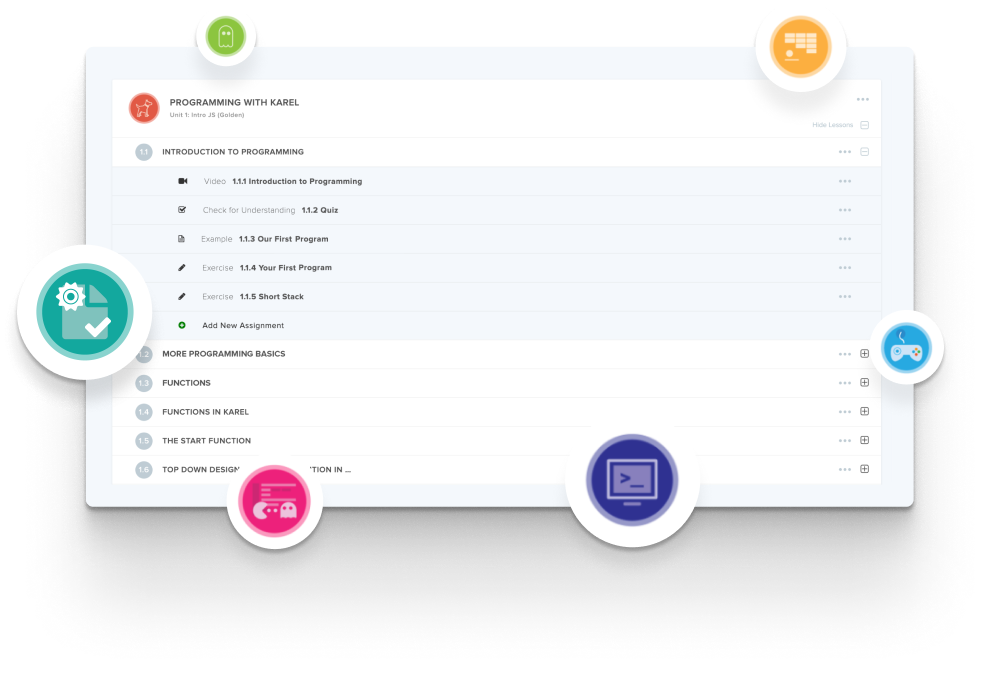
Create and organize Assignments in any CodeHS course that you're teaching. You can even add custom assignments to pre-existing CodeHS courses.
Learn MoreDidn't find what you were looking for? Here are a few links that might be useful to you.
Three frameworks, all at 100%: New Jersey 9-12 Computer Science, New Jersey 9-12 Design Thinking, and the combined New Jersey Computer Science and Design Thinking standards. It is the only course in this set that covers the Design Thinking strand.
The two courses are the same 130 hours with the same units, except this one adds a Computing and the Environment project that covers the New Jersey 9-12 Design Thinking standards at 100%, which the other does not cover at all. If you need the Design Thinking component, take this one; otherwise they teach the same material.
JavaScript. Students start with Karel, then move through graphics, control structures, functions and parameters, and basic data structures.
No. The course teaches the foundations of computer science and basic programming from the start, with an emphasis on logical thinking and problem-solving. The description says students finish having covered material equivalent to a college introductory computer science course.
CodeHS places it at 9th grade in the New Jersey High School Computer Science pathway, and lists it for grades 9 through 12 in the broader New Jersey state pathway.
Students complete four major projects over the course, plus a final project of their own design. Tell a Story — Students write a JavaScript program that tells a graphical story. The Effects of the Internet — Students choose an innovation, research its positive and negative impacts, and develop a computational artifact that presents their findings. Present a Data-Driven Insight — Students answer a question of their choosing by building a data visualization from a publicly available data set. Computing and the Environment — Students investigate an environmental issue, design an innovative solution, and create a computational artifact that demonstrates both. Additional supplemental projects include Breakout, Tic Tac Toe, and a Helicopter Game.
About 130 contact hours, built to run across a full school year. A pretest and posttest are included so you can measure growth.