


IB Computer Science SL Resources
- Level High School
- Contact Hours 100
A collection of CodeHS lessons aligned to the 2025 IB Computer Science guide spanning computational thinking, Python programming, algorithms, computer systems, networks, cryptography, databases, and artificial intelligence. Teachers can use it to locate and assign content that maps to specific IB topics.
Activities in this course require student access to third party AI tools including ChatGPT; Gemini; Microsoft Copilot; Google Teachable Machine; Stable Diffusion (Hugging Face).
Please review the tools listed in the course syllabus.
To view the entire syllabus, click here or click to explore the full course.
MODULES - 18
Students learn what algorithms are, how the same process can be represented in natural language, flowcharts, pseudocode, and code, and how to move between those representations.
Students learn the basics of programming by writing programs that interact with users through the keyboard.
Students teach their programs to make decisions based on the information it receives.
Students learn how to write more efficient code by using loops as shortcuts.
Students learn how their programs can be decomposed into smaller pieces that work together to solve a problem.
Students learn more sophisticated strategies for manipulating text in their programs.
Students learn how tuples and lists are formed and the various methods that can alter them.
Students learn to build more complex programs that make use of grids and dictionaries.
Students analyze how long algorithms take to run, express efficiency in Big O notation, and implement and compare the standard search and sort algorithms.
Students learn to read, write, and process information from text files.
Learn the principles of object-oriented design.
Students explore the structure and design of the internet and networks, and how this design affects the reliability of network communication, the security of data, and personal privacy. Students will learn how the Internet connects computers all over the world by use of networking protocols.
Students work with the seven logic gates, move between truth tables, Boolean expressions, and logic diagrams, and simplify circuits using Boolean algebra and Karnaugh maps.
Students study how the internet is built and operated, from network devices and protocols through IP addressing, routing, network design, and network security and management.
In this project, students will create a "magazine" that explains key concepts about Local Area Networks (LANs), topologies, Ethernet standards, and LAN cabling. Students will research and present the information in a magazine-style layout with sections, images, and creative design.
Students dive into the history of cryptography systems, the motivation behind using encryption systems, and modern cryptography systems. This includes explaining the core concepts of Public Key Infrastructure and hash functions. Students will also explore the importance of digital certificates, and authentication methods.
In this module, students will explore the fundamentals of SQL and relational databases, including structuring data into tables and writing basic SELECT queries with filters.
Students examine how AI models are trained, where bias and hallucinations come from, the risks of deepfakes and misinformation, and the hardware that makes machine learning possible.
| Standards Framework | Alignment |
|---|---|
| IB Computer Science SL | 69% View |
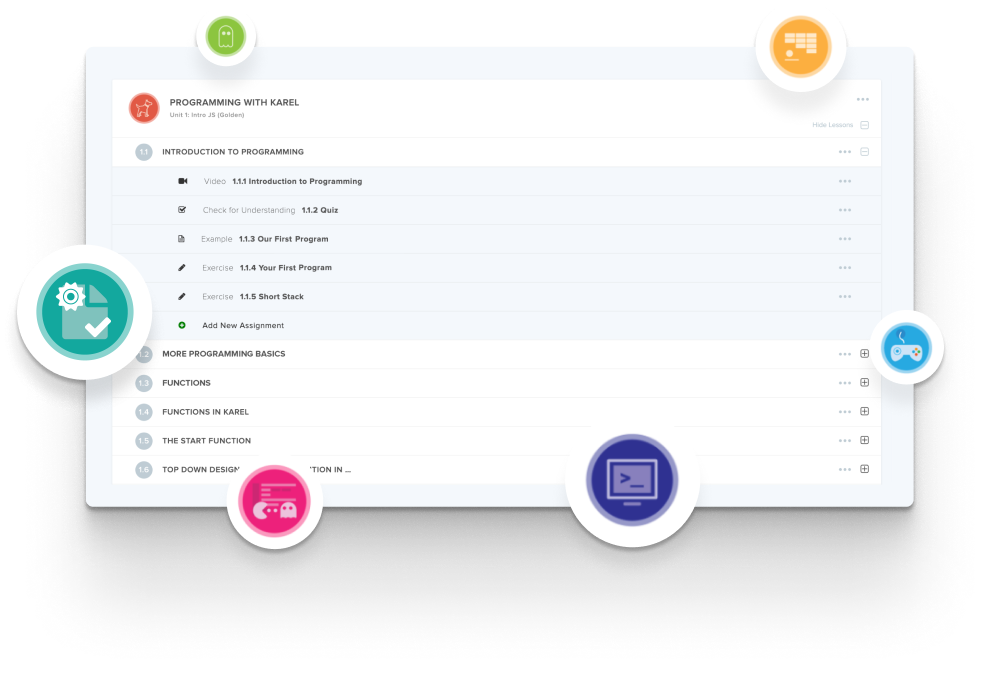
Create and organize Assignments in any CodeHS course that you're teaching. You can even add custom assignments to pre-existing CodeHS courses.
Learn MoreDidn't find what you were looking for? Here are a few links that might be useful to you.
No. It is a curated library of existing CodeHS lessons organized against the 2025 IB Computer Science SL framework, not a sequenced course. The units are grouped by topic rather than ordered into an IB scope and sequence, so if you copy the whole collection into a section you will still need to decide the teaching order, the pacing, and how the topics connect across the year. It also does not prepare students for IB assessments. There is no Internal Assessment support, no exam-style practice, and no Paper 1, 2, or 3 preparation. Every lesson in the collection exists to cover a standard, not to rehearse an assessment format. Assessment preparation remains your responsibility.
The IB Computer Science curriculum was updated in 2025, with students beginning the new course in Fall 2025 and sitting their first exams in 2027. For that framework, CodeHS offers IB Computer Science SL Resources, a library of lessons pulled from across the CodeHS catalog and organized against the 2025 SL standards. It covers computational thinking, Python programming, algorithms, computer systems, logic gates, networks, cryptography, databases, and AI. It is not a complete mapping of the framework. Visit the standards mapping page to see which standards have content and which do not.
Work standard by standard rather than start to finish. The standards mapping page lists the specific CodeHS lessons mapped to each statement, down to the individual lesson. Click into a lesson to preview the activities, then assign it or copy it into your existing IB section. Where a statement lists no lessons, CodeHS does not yet have content aligned to it.