



Florida Discovering Computer Science
- Level High School
- Contact Hours 125
- Timeframe Year
The Florida Discovering Computer Science course introduces high school students to the fundamental principles of computer science, emphasizing its role as a tool for problem-solving, communication, and personal expression. This course highlights the visible and impactful aspects of computing, encouraging students to explore how computer science influences the world around them. Students will engage with the design process, understand how data can solve widespread issues, and learn how physical computing with circuit boards can facilitate various input and output functions.
To view the entire syllabus, click here or click to explore the full course.
MODULES - 11
Students delve into key areas such as personal data collection, the reliability of online information, cyber ethics and laws, personal data security, cybersecurity essentials, and strategies to combat common cyber threats and their prevention, equipping individuals with the knowledge to navigate the digital landscape responsibly and securely.
Students explore the structure and design of the internet and networks, and how this design affects the reliability of network communication, the security of data, and personal privacy. Students will learn how the Internet connects computers all over the world by use of networking protocols.
Students learn about the physical elements of computers and networking such as motherboards, RAM, routers, and the use of port numbers, ethernet, and wireless devices.
In this module, students are introduced to the fundamentals of programming by learning how to write basic code in Python using print statements, variables, user input, and arithmetic expressions. They’ll explore data types, string operations, comments, and the role of programming languages in creating interactive programs.
In this module, students expand their programming skills by working with Boolean values, logical and comparison operators, and if statements to create decision-making programs. They apply their understanding to secure coding practices and explore how programming decisions align with real-world cybersecurity policies and principles.
Students learn how to write more efficient code by using loops as shortcuts.
Students write a program to provide feedback on whether the entered password is correct or incorrect.
Students learn the key roles and responsibilities of members of a software development team.
Students will learn and apply the process of the data science life cycle. This includes asking statistical questions, collecting or obtaining reliable raw data, analyzing the data using measures of central tendency and spread and interpreting and summarizing the results.
In this module, students will gain an understanding of the main concepts and vocabulary around AI.
In this project, students will learn the theory and practice of the engineering design process. This project allows students to think creatively about the applications of the concepts covered in the course, and create something of personal value.
Explore programs that your students will build throughout this course!
Here are a few examples of teacher resources and materials to use in the Florida Discovering Computer Science course
| Standards Framework | Alignment |
|---|---|
| Florida Discovering Computer Science | 100% View |
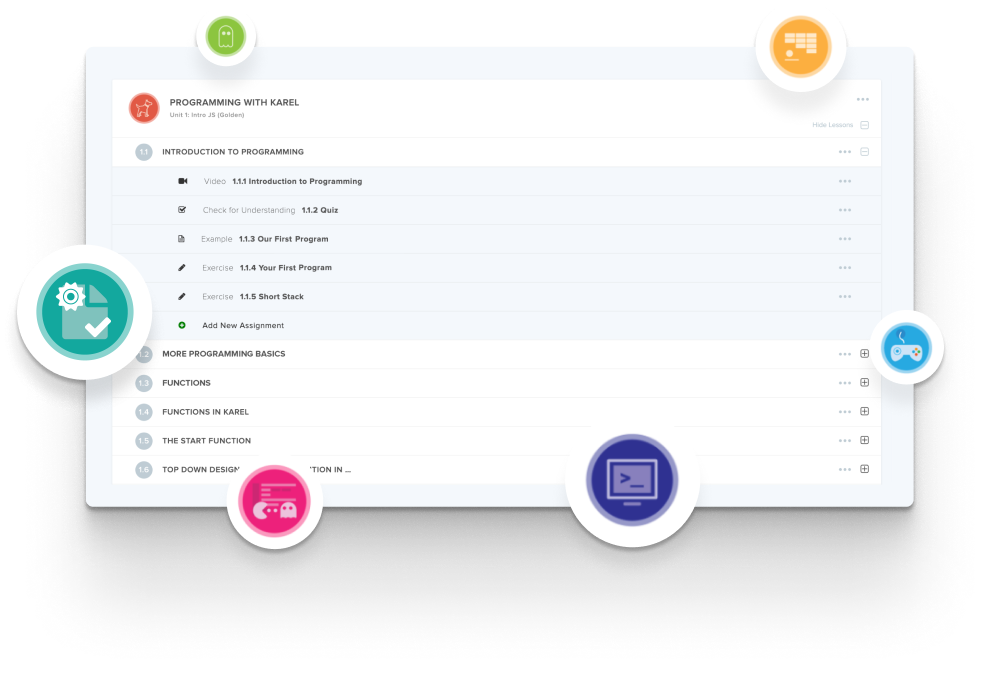
Create and organize Assignments in any CodeHS course that you're teaching. You can even add custom assignments to pre-existing CodeHS courses.
Learn MoreDidn't find what you were looking for? Here are a few links that might be useful to you.
A high school course introducing core CS principles — problem-solving, communication, creativity, and real-world applications through design, data analysis, and physical computing. 125 hours (cybersecurity, internet, Python, data science, AI); no prerequisites.