


Tennessee Coding I in Python
- Level High School
- Contact Hours 150
- Timeframe Year
The Tennessee Coding I course introduces students to the fundamentals of computer programming. The course focuses on standard programming techniques, logical problem-solving, and creating simple applications. By the end, students will be able to plan multistep solutions, write and revise code, translate workflows into programming instructions, and troubleshoot/debug software for proper execution.
To view the entire syllabus, click here or click to explore the full course.
MODULES - 15
Students delve into key areas such as personal data collection, the reliability of online information, cyber ethics and laws, personal data security, cybersecurity essentials, and strategies to combat common cyber threats and their prevention, equipping individuals with the knowledge to navigate the digital landscape responsibly and securely.
Students learn about the world Tracy lives in and how to write commands that she will understand. They also look at a history of programming languages and some of the different characteristics programming languages can have.
Students learn the basics of programming by writing programs that interact with users through the keyboard.
Students compare and contrast common operating systems (Windows, Linux, OS) and explain the importance of application security. They will investigate security options and implement user accounts to enforce authentication and authorization. Students will also demonstrate how to work with basic and advanced command prompts.
Students teach their programs to make decisions based on the information it receives.
Students learn how to write more efficient code by using loops as shortcuts.
Students learn how their programs can be decomposed into smaller pieces that work together to solve a problem.
Students learn about the benefits and dangers of collecting and storing large sets of data. They will learn how to prevent attacks such as SQLi and XSS using programming controls. Students will also learn about risk management and how to identify, assess, prioritize, and minimize risks.
Students go through the design process to develop a website that solves a problem in their community.
Students learn how tuples and lists are formed and the various methods that can alter them.
Students learn to build more complex programs that make use of grids and dictionaries.
Students learn to read, write, and process information from text files.
In this module, students will learn and use the software development life cycle to create a simple app that will solve an everyday problem.
Students learn the key roles and responsibilities of members of a software development team.
Explore programs that your students will build throughout this course!
| Standards Framework | Alignment |
|---|---|
| Tennessee Coding I | 100% View |
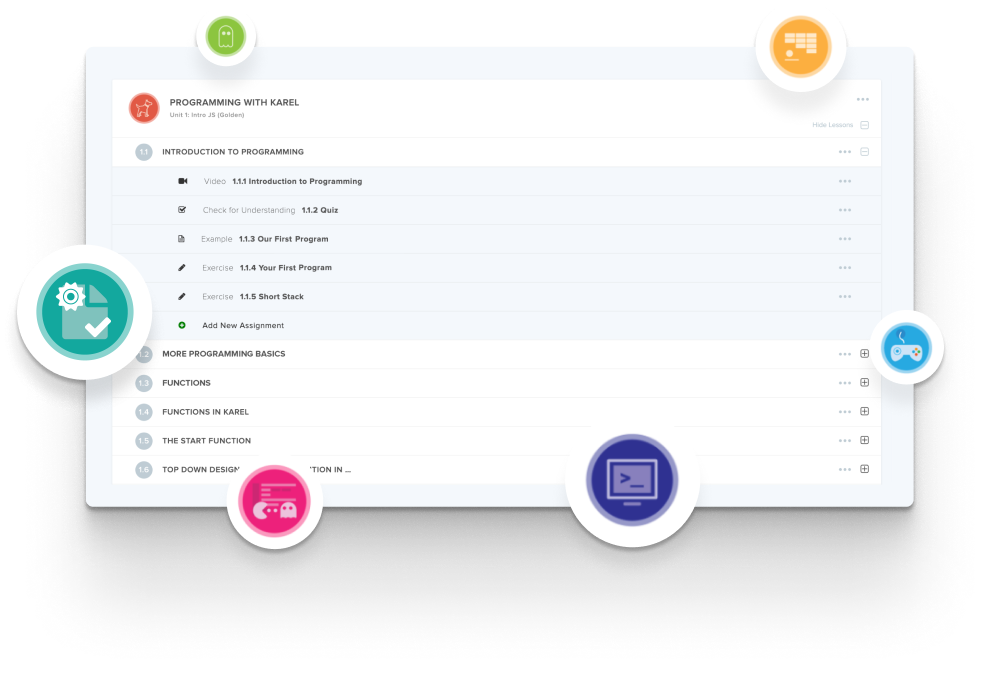
Create and organize Assignments in any CodeHS course that you're teaching. You can even add custom assignments to pre-existing CodeHS courses.
Learn MoreDidn't find what you were looking for? Here are a few links that might be useful to you.
You also might like
Which python course should I use? Click here
This course is the Python version of Tennessee Coding I. It covers the same Tennessee Computer Science standards as our original JavaScript-based Coding I course, but all lessons, examples, and projects use Python.
The course includes units on 2D lists and reading/writing files, along with the core programming fundamentals you'd expect from an intro coding course, including variables, loops, conditionals, and functions.