



Utah Computer Programming 1 and 2
- Level High School
- Contact Hours 150
- Timeframe Year
Utah Computer Programming 1 and 2 introduce students to the fundamentals of computer programming, with an emphasis on helping students develop logical thinking and problem-solving skills. Students begin by learning to design, code, and test their programs while applying mathematical concepts. Students then move to more advanced programming concepts and learn to create more powerful programs using functions, strings, data structures, file i/o operations, objects, and programming with AI.
Activities in this course require student access to third party AI tools including ChatGPT; Gemini; Microsoft Copilot; Google AI Experiments (Quick, Draw!, etc.); Google Say What You See.
Please review the tools listed in the course syllabus.
To view the entire syllabus, click here or click to explore the full course.
MODULES - 19
Students learn the basics of programming by giving Karel the Dog commands in a grid world.
Students learn the basics of programming by writing programs that interact with users through the keyboard.
Students write a program that allows users to create their own Mad Lib stories using variables and user input.
Students teach their programs to make decisions based on the information it receives.
Students write a program that quizzes users on a series of multiple-choice questions and checks their answers.
Students learn how to write more efficient code by using loops as shortcuts.
Students write a program to provide feedback on whether the entered password is correct or incorrect.
Students learn the key roles and responsibilities of members of a software development team.
Students learn how their programs can be decomposed into smaller pieces that work together to solve a problem.
Students learn more sophisticated strategies for manipulating text in their programs.
Students program a classic two-player game played with a 6 sided die.
Students learn how tuples and lists are formed and the various methods that can alter them.
Students learn to build more complex programs that make use of grids and dictionaries.
Students write a program for a word guessing game.
Students learn to read, write, and process information from text files.
Students learn the principles of object-oriented design.
In this module, students will gain an understanding of the main concepts and vocabulary around AI.
Students learn potential career paths in the field of computer science.
Explore programs that your students will build throughout this course!
| Standards Framework | Alignment |
|---|---|
| Utah Computer Programming 1 | 100% View |
| Utah Computer Programming 2 | 100% View |
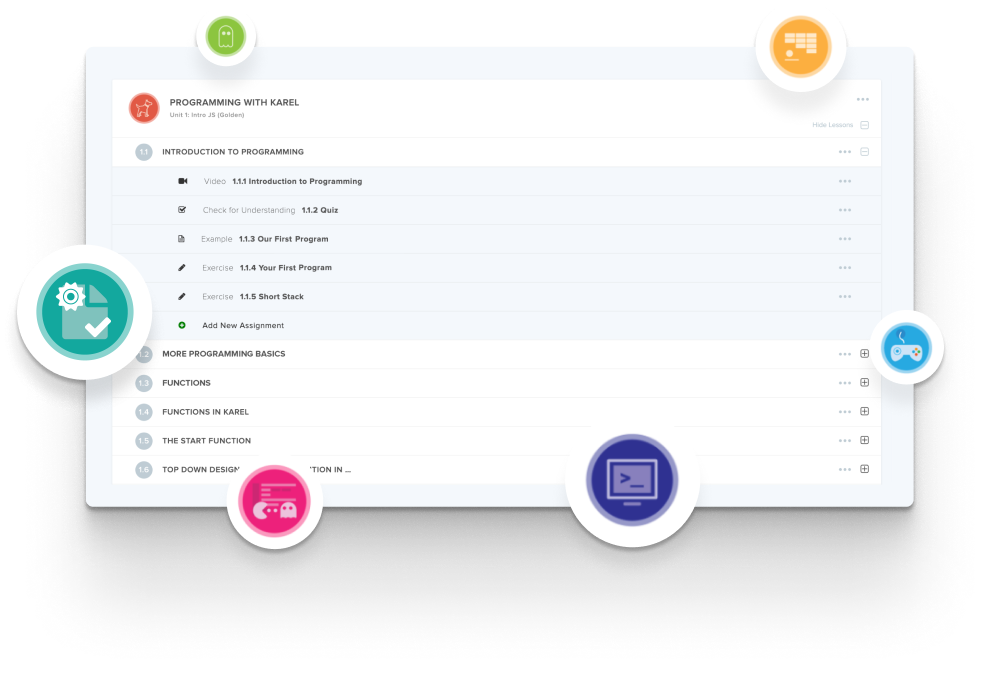
Create and organize Assignments in any CodeHS course that you're teaching. You can even add custom assignments to pre-existing CodeHS courses.
Learn MoreDidn't find what you were looking for? Here are a few links that might be useful to you.
You also might like
Which python course should I use? Click here
Yes. This is CodeHS's updated Utah Computer Programming 1 and 2 course, rebuilt for Utah's revised Computer Programming standards, and it covers both the Computer Programming 1 and Computer Programming 2 standards in full. Because it spans the whole sequence, this is the most complete option for schools that want every standard covered in one course.
CodeHS offers the Utah Computer Programming curriculum in three configurations built from the same content, so schools can pick whichever fits their schedule. This course is the full year in one place, which suits schools that teach Computer Programming as a year-long class. Schools that run the two courses as separate semester offerings can use Utah Computer Programming 1 for the first semester and Utah Computer Programming 2 for the second. The lessons and projects are the same either way.
Yes. Utah Computer Programming 1 and 2 includes a full module on artificial intelligence, added to meet Utah's updated standards. Students learn how to use AI tools safely and honestly, compare generative and predictive AI, explore how large language models work, practice writing and refining prompts, examine who builds AI and what biases it can carry, and complete a project where they build software with help from an AI chatbot and then disclose how they used it. The course also covers cyber ethics, personal data security, and software licensing.