



Indiana Computer Science III: Cybersecurity
- Level High School
- Contact Hours 145
- Timeframe Year
This course introduces secure software development, security threats, principles, strategies, coding techniques, and tools that can help make software fault-tolerant and resistant to attacks. Students also learn about cryptography, information theory, computational complexity, and number theory.
To view the entire syllabus, click here or click to explore the full course.
MODULES - 14
Students explore the basics of cybersecurity. Students will learn about why cybersecurity is important, recent threats to cybersecurity, and different careers in the field.
Students dive into the history of cryptography systems, encryption systems, and basic cryptography systems. Additionally, students explore topics on how to use cryptography, cryptology, and cryptanalysis to decode a message without the use of a key.
Students create a newscast in teams! Each team will be given a different **classic cipher** (beyond Caesar and Vigenere) to research and address in their newscast.
Students learn advanced principles of cryptology and explore concepts of encrypted email, digital certificates, private key certificates, different types of SSL certificates, the chain of trust and how a Certificate Authority (CA) works.
Students explore steganography and create an encryption algorithm to conceal and hide a message within the pixels of an image!
Students compare and contrast common operating systems (Windows, Linux, OS), investigate security options and implement user accounts to enforce authentication and authorization.
Students learn about the physical elements of computers and networking, such as motherboards, RAM, routers, and the use of port numbers, ethernet, and wireless devices.
Students explore the troubleshooting methodology and utilize it to solve sample IT support issues.
Students learn what happens when running a web application and how to look inside web apps using developer tools, source code, and more. Students learn basic SQL and common attacks like SQLi.
Students develop a training policy that informs employees on matters of network security and details the company policy on preventative measures employees should take.
Students demonstrate skills in conducting vulnerability scans and recognizing vulnerabilities in security systems.
Students design and create a board game or a card game that will help players to identify randomized security vulnerabilities and appropriate defenses.
Explore programs that your students will build throughout this course!
Here are a few examples of teacher resources and materials to use in the Indiana Computer Science III: Cybersecurity course
The CodeHS Cybersecurity Level 1 Certification offers high school students the opportunity to validate their mastery of Cybersecurity, giving them a competitive advantage when entering college or the workforce.
Learn More| Standards Framework | Alignment |
|---|---|
| Indiana Computer Science 3: Cybersecurity | 100% View |
| Certiport Cybersecurity | 52% View |
| CompTIA Tech+ | 52% View |
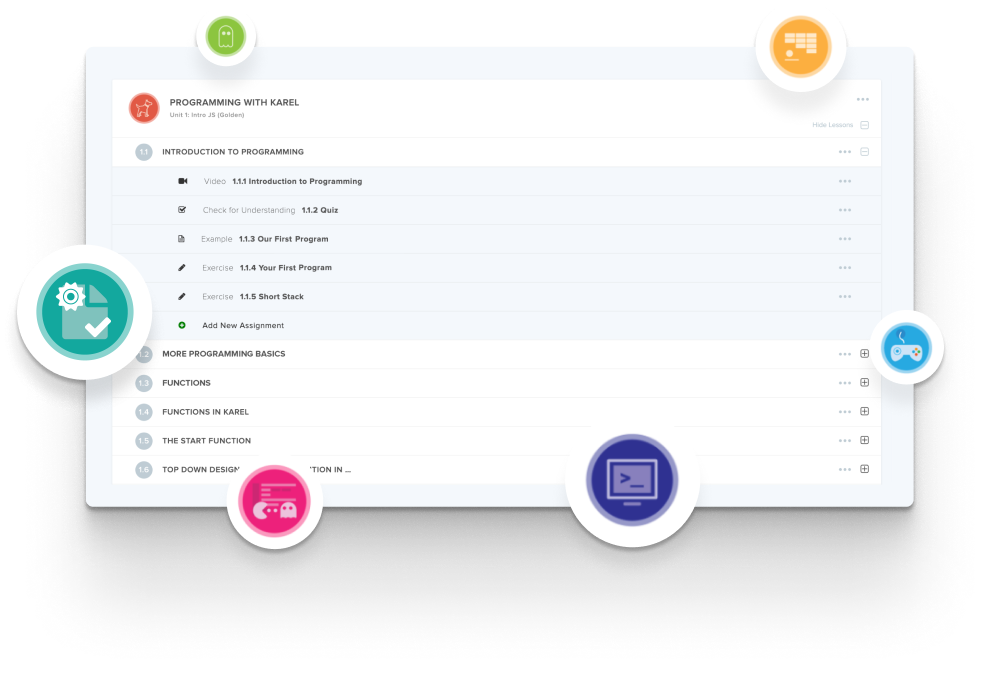
Create and organize Assignments in any CodeHS course that you're teaching. You can even add custom assignments to pre-existing CodeHS courses.
Learn MoreDidn't find what you were looking for? Here are a few links that might be useful to you.
It covers 100% of the Indiana Computer Science 3: Cybersecurity standards. The CodeHS standards page shows each standard alongside the lesson that covers it.
This course is recommended for students in 12th grade.
Secure software development, security threats and strategies, coding techniques and tools that make software fault-tolerant and attack-resistant, plus cryptography, information theory, computational complexity and number theory.
A classic cipher newscast, a security assessment report, a troubleshooting project, a steganography project, a risk-management game, a written policy project, and a final course project.
About 145 contact hours, built to run across a full school year.