



AP Computer Science Principles in Python
- Level High School
- Contact Hours 125
- Timeframe Year
AP Computer Science Principles introduces students to the foundational concepts of computer science and programming in Python. With a unique focus on creative problem solving and real-world applications, students are challenged to explore how computing and technology can impact the world. This refreshed version includes a new practice performance task, additional exercises to strengthen foundational Python skills, and new notes and quizzes designed to better prepare students for the AP CSP exam.
To view the entire syllabus, click here or click to explore the full course.
MODULES - 21
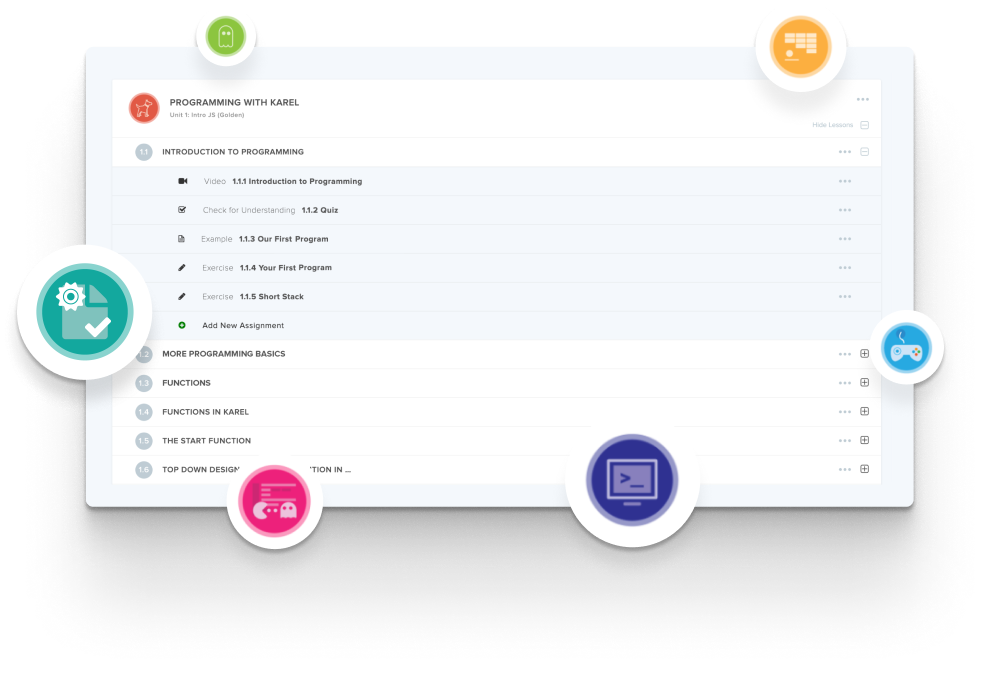
Karel is a dog that only knows how to move, turn left, and place tennis balls in his world. You can give Karel these commands to instruct him to do certain things. We use Karel to show you what it means to program, and allow you to focus on problem-solving.
In this project, students apply their knowledge of Karel to express their artistic side and create an image using Ultra Karel commands.
Students learn the basics of Python, including variables, user input, control structures, functions with parameters and return values, and basic graphics, and how to send messages to objects.
Students learn how to use booleans and logical operators with control structures to make more advanced programs in Python.
Students learn how to write reusable code with functions and parameters.
Students apply what they've learned from the previous module to write reusable code with functions and parameters.
Students will learn the basics of lists in Python while exploring tuples and lists. Students will explore how to create each of these and the various methods to access or alter them.
Students learn about the various ways to represent information digitally including number systems, encoding data, programmatically creating pixel images, comparing data encodings, compressing and encrypting data.
In this module, students practice the skills necessary to succeed in their Create Performance Task.
Students explore the structure and design of the internet, and how this design affects the reliability of network communication, the security of data, and personal privacy.
Students apply their knowledge of the internet as they look at the impacts that it has on our world.
Students explore using computational tools to store massive amounts of data, manipulate and visualize data, find patterns in data, and pull conclusions from data.
Students apply data concepts into a project where they can explore their own data application.
Students use more sophisticated strategies for manipulating text in their programs - slicing, concatenating, and formatting.
Students build a personal data tracking application that directly practices all Create Performance Task code requirements: input, list, procedure with parameters, algorithm with sequencing/selection/iteration, procedure call, and output.
Students complete a research project on the impact of a computing innovation.
Students review of the topics covered in the course and practice solving AP Exam-style multiple-choice questions.
Students learn the theory and practice of user interface design. Students learn about what makes an engaging and accessible user interface and will employ an iterative design process including rapid prototyping and user testing to design and develop their own engaging programs.
Final exam for the course.
Explore programs that your students will build throughout this course!
With the CodeHS online AP Computer Science Principles Professional Development course, we'll train teachers at your school to teach an excellent AP Computer Science Principles course. Teachers will gain the skills, pedagogical knowledge, resources, and confidence to teach AP CS Principles. No programming experience is required.
View Units CodeHS PD Options| Standards Framework | Alignment |
|---|---|
| AP Computer Science Principles 2020 | 100% View |
Create and organize Assignments in any CodeHS course that you're teaching. You can even add custom assignments to pre-existing CodeHS courses.
Learn MoreDidn't find what you were looking for? Here are a few links that might be useful to you.
Yes. AP Computer Science Principles in Python from CodeHS is a year-long, college-level course designed as a first computer science course for high school students. It assumes no background and teaches broad computing concepts, from programming and algorithms to data, the internet, and the global impact of technology, using Python. Students can take it as their entry point into CS and earn college credit with the AP exam.
No. AP Computer Science Principles in Python from CodeHS is designed for students with no prior programming experience. The course starts with the fundamentals and builds up gradually, teaching Python step by step alongside core computing concepts. It's one of the most accessible AP courses, which is why many schools use it to introduce students to computer science.
In AP Computer Science Principles in Python from CodeHS, students write real Python programs and build projects across the course's big ideas, including creative coding, data analysis, and interactive programs. They work with public datasets, create visualizations, and design their own original programs, developing both technical skills and an understanding of how computing shapes the world.
CodeHS AP Computer Science Principles in Python includes a dedicated Create Performance Task module that walks students through the task overview, guidelines, academic integrity rules, planning, and pacing. Students warm up with smaller practice projects first, then plan, build, and document the Python program they submit to the College Board as part of their AP score.
No. CodeHS gives teachers everything they need to teach AP Computer Science Principles in Python, even without a computer science background, including professional development, a pre-approved syllabus, lesson plans, auto-graded exercises, and answer keys. Many successful AP CSP teachers come from other subjects and rely on CodeHS's built-in teacher tools and training to lead the course confidently.
AP Computer Science Principles in Python from CodeHS is a full-year course with about 125 hours of instruction, designed to fit a standard school year before the May AP exam. Everything runs in the browser on the CodeHS platform, so there's nothing to install. Students can code in Python from any computer, including Chromebooks, with just an internet connection.
Yes. CodeHS AP Computer Science Principles is endorsed by the College Board, which means it has been reviewed and confirmed to meet all AP curriculum requirements. The course prepares students for both parts of the exam: the end-of-course multiple-choice test and the Create Performance Task. CodeHS teachers who responded to our 2025 AP exam survey reported a 67% passing rate, compared with 62% nationally.
Both CodeHS courses cover the same College Board AP Computer Science Principles framework and prepare students for the same exam; the difference is the programming language. The Python version teaches coding in Python, while the JavaScript version uses JavaScript. Schools often choose the Python version for its readable, beginner-friendly syntax and its strong connection to data science and AI, the fields where Python is dominant.
Most students take AP Computer Science Principles before AP Computer Science A. AP Computer Science Principles in Python from CodeHS is a broad, beginner-friendly introduction with no prerequisites, while AP Computer Science A is a deeper, Java-based programming course. Taking Principles first builds the confidence and coding foundation that makes the more intensive AP Computer Science A course more approachable.