




AP Computer Science Principles in Python (2025)
- Level High School
- Contact Hours 125
- Timeframe Year
AP Computer Science Principles introduces students to the foundational concepts of computer science and programming in Python. With a unique focus on creative problem solving and real-world applications, students are challenged to explore how computing and technology can impact the world.
To view the entire syllabus, click here or click to explore the full course.
MODULES - 20
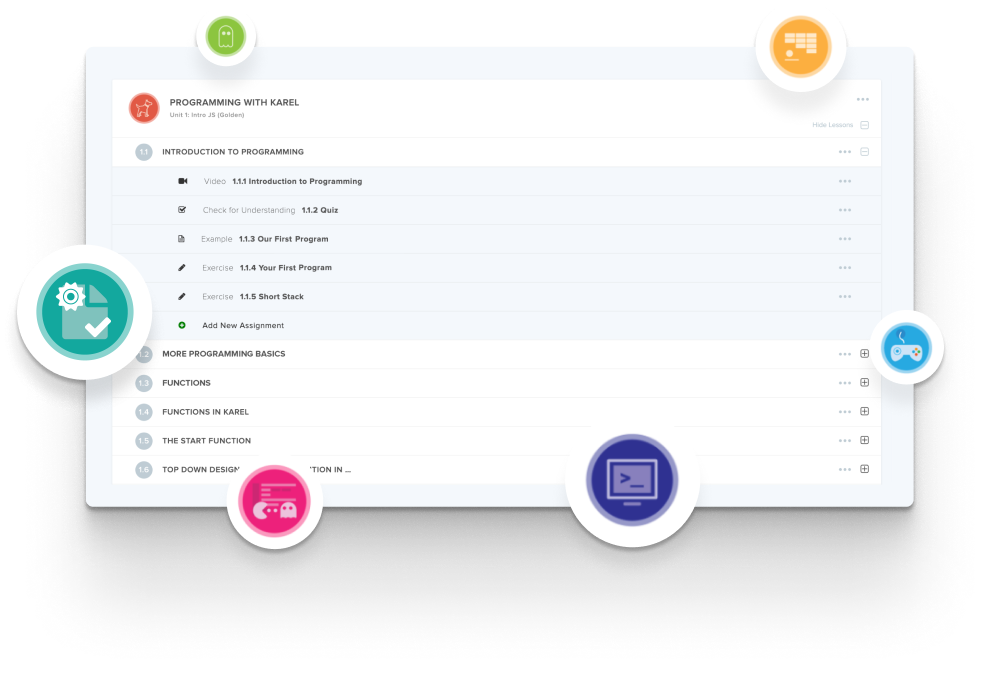
Karel is a dog that only knows how to move, turn left, and place tennis balls in his world. You can give Karel these commands to instruct him to do certain things. We use Karel to show you what it means to program, and allow you to focus on problem-solving.
In this project, students apply their knowledge of Karel to express their artistic side and create an image using Ultra Karel commands.
Students learn the basics of Python, including variables, user input, control structures, functions with parameters and return values, and basic graphics, and how to send messages to objects.
Students learn how to use booleans and logical operators with control structures to make more advanced programs in Python.
Students learn how to write reusable code with functions and parameters.
Students apply what they've learned from the previous module to write reusable code with functions and parameters.
Students will learn the basics of lists in Python while exploring tuples and lists. Students will explore how to create each of these and the various methods to access or alter them.
Students learn about the various ways to represent information digitally including number systems, encoding data, programmatically creating pixel images, comparing data encodings, compressing and encrypting data.
Students apply knowledge about digital representation of data in a real-world application of using steganography to encrypt information.
Students apply data structure and digital information concepts together to create their own image filters.
Students explore the structure and design of the internet, and how this design affects the reliability of network communication, the security of data, and personal privacy.
Students apply their knowledge of the internet as they look at the impacts that it has on our world.
Students explore using computational tools to store massive amounts of data, manipulate and visualize data, find patterns in data, and pull conclusions from data.
Students apply data concepts into a project where they can explore their own data application.
While the performance task is no longer a graded part of the AP test, the skills needed for the performance task are still a part of the curriculum. This module will give students a chance to apply these concepts in a project format.
Students review of the topics covered in the course and practice solving AP Exam-style multiple-choice questions.
Students learn the theory and practice of user interface design. Students learn about what makes an engaging and accessible user interface and will employ an iterative design process including rapid prototyping and user testing to design and develop their own engaging programs.
Final exam for the course.
Explore programs that your students will build throughout this course!
CodeHS is recognized by the College Board as an endorsed provider of curriculum and professional development for AP® Computer Science Principles (AP CSP). Using an Endorsed Provider affords schools access to resources including an AP CSP syllabus pre-approved by the College Board’s AP Course Audit, and officially recognized professional development that prepares teachers to teach AP CSP. This endorsement affirms only that components of CodeHS’s offerings are aligned to all the AP Curriculum Framework standards and the AP CSP assessment.
Here are a few examples of teacher resources and materials to use in the AP Computer Science Principles in Python (2025) course
With the CodeHS online AP Computer Science Principles Professional Development course, we'll train teachers at your school to teach an excellent AP Computer Science Principles course. Teachers will gain the skills, pedagogical knowledge, resources, and confidence to teach AP CS Principles. No programming experience is required.
View Units CodeHS PD Options| Standards Framework | Alignment |
|---|---|
| North Carolina Computer Science I | 100% View |
| Nevada 9-12 | 100% View |
| Nebraska Foundations of Computing | 100% View |
Create and organize Assignments in any CodeHS course that you're teaching. You can even add custom assignments to pre-existing CodeHS courses.
Learn MoreDidn't find what you were looking for? Here are a few links that might be useful to you.
You also might like
Which python course should I use? Click here
Same course content using JavaScript as a language
Alternative course taking a deeper dive on Cybersecurity using JavaScript as the language
Review course to help students prepare for the AP Test
Introductory course covering the fundamentals of the Python language