


Idaho High School Computer Science
- Level High School
- Contact Hours 145
- Timeframe Year
In this course, students explore many foundational computer science concepts. First, students learn about cybersecurity and how to protect themselves online. Then, students are exposed to IT concepts including binary, networks, physical devices, and how these all work together. Next, students learn about Artificial Intelligence. Students are then introduced to the Python programming language. After building a strong set of coding skills, students learn about data science and use Python to explore data. Finally, students learn about real world applications of computer science.
Activities in this course require student access to third party AI tools including ChatGPT; Gemini; Microsoft Copilot; Google Teachable Machine.
Please review the tools listed in the course syllabus.
To view the entire syllabus, click here or click to explore the full course.
MODULES - 16
Students delve into key areas such as personal data collection, the reliability of online information, cyber ethics and laws, personal data security, cybersecurity essentials, and strategies to combat common cyber threats and their prevention, equipping individuals with the knowledge to navigate the digital landscape responsibly and securely.
Students dive into the history of cryptography systems, the motivation behind using encryption systems, and modern cryptography systems. This includes explaining the core concepts of Public Key Infrastructure and hash functions. Students will also explore the importance of digital certificates, and authentication methods.
In this module, students will learn about the role of an operating system and the resources they manage. They will investigate accessibility and understand its importance in the online space. Students will also learn about software licenses and the purpose of them.
In this module, students explore the structure and design of the internet and networks, and how this design affects the reliability of network communication, the security of data, and personal privacy. Students will learn how the Internet connects computers all over the world by use of networking protocols. They will see how information is conveyed in binary over the Internet.
Students learn about the physical elements of computers and networking such as motherboards, RAM, routers, and the use of port numbers, ethernet, and wireless devices.
In this module, students explore key aspects of AI, including large language models, bias in models, and the impacts they have on our society. They will gain an understanding of how AI works and will be equipped with the skills to use AI responsibly.
In this module, students will learn the basics of programming by writing programs that interact with users through the keyboard. They will explore foundational computer science concepts including variables and comments. This module introduces students to Python, which they use for the remainder of the course.
In this module, students will learn how to use control structures, such as if statements, for loops, and while loops, in their programs. Students teach their programs to make decisions based on the information it receives and learn how to write more efficient code by using loops as shortcuts.
In this module, students will learn how to decompose problems into smaller pieces that work together to solve a problem. Students explore the value and purpose of functions while writing some of their own. They then utilize namespaces, parameters, and exceptions to write more specialized functions.
In this module, students learn how to utilize more complex data structures, including tuples, lists, and dictionaries, in their code. They learn how to construct and use data structures, as well as some common methods to modify data structures.
In this module, students will learn about the software development life cycle and how coding projects are planned and implemented in the real world. Then, students will work on an open-ended group project to practice their programming skills, the development life cycle, and working on a team.
In this module, students will learn the basics of object oriented programming. Students will learn what objects are, create classes, use methods, overload operators, and understand the difference between class and instance variables.
In this module, students are introduced to data science and how they can use Python to analyze and use data. Students will learn and apply the process of the data science life cycle. This includes asking statistical questions, collecting or obtaining reliable raw data, analyzing the data using measures of central tendency and spread and interpreting, and summarizing the results.
Students will use and analyze data to better understand a problem, measure the scope of a problem, or understand how people are affected by the problem. They will learn more about cleaning a dataset and filtering by column, rows, and conditions.
In this module, students will understand how data can be used to tell a story. They will review infographics to understand how they utilize data. Students will learn how to use Python to make visualizations of data.
In this module, students will learn about several examples of real world applications of computer science. Students will research specific examples of how computing has revolutionized industry and society.
Explore programs that your students will build throughout this course!
Here are a few examples of teacher resources and materials to use in the Idaho High School Computer Science course
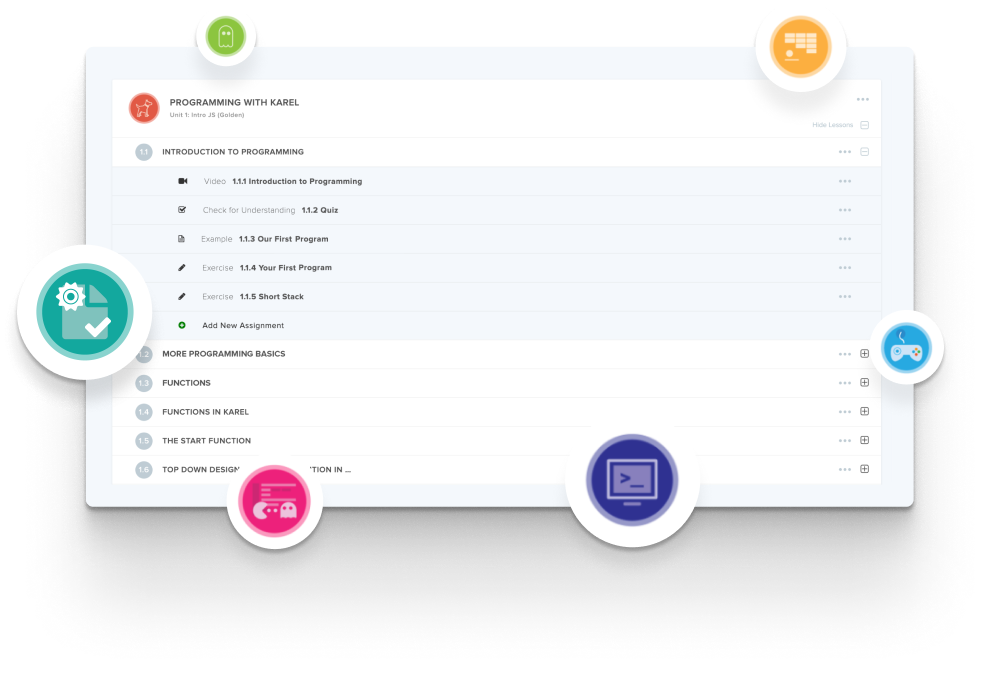
Create and organize Assignments in any CodeHS course that you're teaching. You can even add custom assignments to pre-existing CodeHS courses.
Learn MoreDidn't find what you were looking for? Here are a few links that might be useful to you.
A year-long (145-hour) course introducing a wide range of CS topics including digital citizenship, cybersecurity, networks, artificial intelligence, programming, and data science.
Idaho high schoolers (grades 9-12); no prerequisites, built for beginners. It runs entirely in the browser.