




Computing Ideas (Lovelace)
- Level High School
- Contact Hours 155
- Timeframe Year
The Computing Ideas course is a first year computer science course with a unique focus on creativity and problem-solving. Students explore several important topics of computing, such as programming, digital citizenship, networks, and web design.
To view the entire syllabus, click here or click to explore the full course.
MODULES - 10
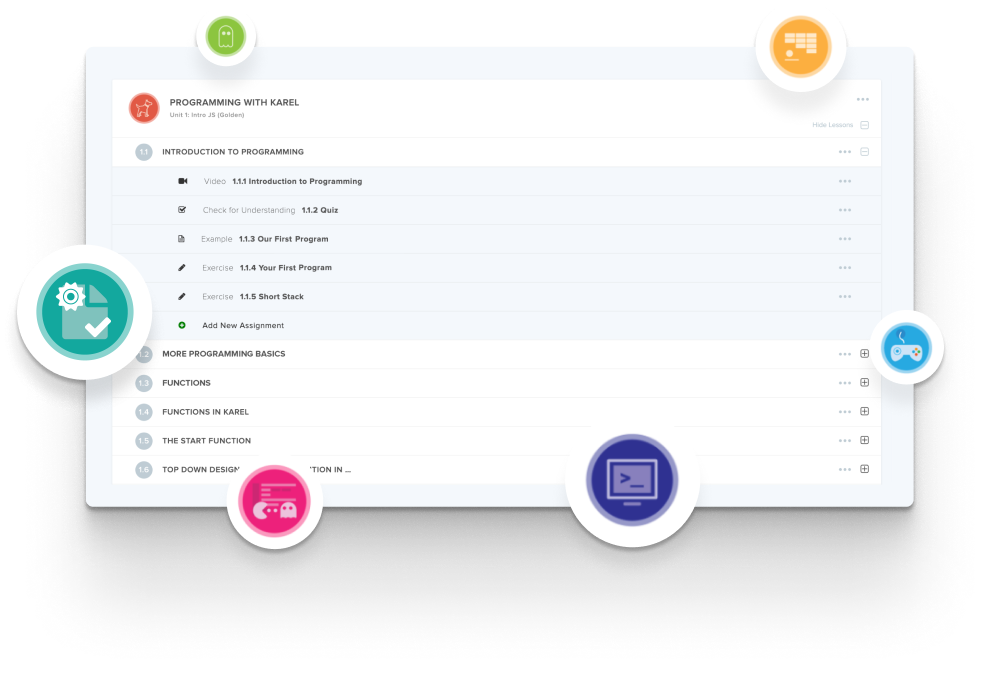
Students explore the fundamentals of programming by giving commands to Karel the Dog using JavaScript syntax, functions, control structures, and proper programming formatting.
Students dive into the history of computing, consider how computing impacts today's world, and learn about the various parts that make up modern computers.
Students create a short presentation about a specific model of a computer from an early model to a computer that is still being developed (phones, robots, drones).
Students learn the basics of HTML, CSS, and the processes involved in viewing web pages on the internet. Students create several simple web pages using the CodeHS online editor to gain practice!
Students build their very own homepage, hosted at a custom URL!
Students learn about the various ways we represent information digitally including number systems, encoding data, and creating pixel images.
Students explore the structure and design of the internet, and how this design affects the reliability of network communication, the security of data, and personal privacy.
Students choose an innovation that was enabled by the Internet and explore the effects of this innovation!
Students learn Internet etiquette, ways to stay safe on the world wide web, potential effects of our digital footprints, how to protect information from online risks, and the implications of cyberbullying.
Students create a Public Service Announcement (PSA) to teach their peers about digital citizenship and cyber hygiene.
Explore programs that your students will build throughout this course!
Here are a few examples of teacher resources and materials to use in the Computing Ideas (Lovelace) course
Prepare to teach Computing Ideas! With this online PD course, teachers gain the skills, pedagogical knowledge, resources, and confidence to lead a excellent introductory computer science class with CodeHS—no programming experience is required.
View Units CodeHS PD OptionsCreate and organize Assignments in any CodeHS course that you're teaching. You can even add custom assignments to pre-existing CodeHS courses.
Learn MoreDidn't find what you were looking for? Here are a few links that might be useful to you.
You also might like
First semester of Computing Ideas
Second semester of Computing Ideas
Semester of introductory programming modules
It covers 100% of both the Utah 6 and Utah 7 standards, and it maps at 40% or above to more than a hundred other frameworks, the widest coverage of any course in the catalogue. It reaches 87% on Nevada Tech 6-8, 85% on Virginia 8, and 82% on North Carolina Computer Science I.
Programming, digital citizenship, networks and web design, framed around creativity and problem-solving. The description calls it a first-year computer science course.
Yes. Teaching Computing Ideas is attached as its professional development course.
CodeHS lists it in the Middle School Pathway for grades 6 through 8, the CodeHS 9-12 pathway at 9th, and the Indiana, New Jersey, Tennessee and Illinois state pathways in the 6th to 9th grade range. It straddles middle and high school.
No. It is a first-year computer science course.
About 155 contact hours, built to run across a full school year.