





Intro to Programming in JavaScript with Arduino
- Level High School
- Contact Hours 175
- Timeframe Year
This course merges the Introduction to Computer Science in JavaScript and the Introduction to Physical Computing with Arduino courses. This course provides the prerequisite information needed before students apply programming concepts to their physical Arduino device.
To view the entire syllabus, click here or click to explore the full course.
MODULES - 16
Students learn the basics of programming by giving Karel the Dog commands in a grid world.
Students apply all the foundational concepts from Intro to Karel to solve new challenges.
Students learn the basics of JavaScript including variables, user input, mathematics, and basic graphics.
Students learn how to pair program while tackling more challenging tasks with JavaScript graphics.
Students go through the basics of the Arduino device, such as how to light up and change the brightness of LEDs, and learn how variables can be used to write more versatile programs. Students build circuits to control LEDs and motors with the Arduino and explore how pseudocode can be used to structure programs from the start.
Students learn how to use control structures such as if/else statements and loops to make advanced programs in JavaScript.
Students apply the foundational concepts from the Control Structures unit to solve new challenges.
Students learn to write reusable code with functions and parameters.
Students use what they have learned in the Functions unit to solve challenges.
Students learn how to apply control structures, such as if/else statements and loops to create programs that will react to the outside world. They build programs that use sensors to detect temperature, light, and distance and make decisions based on the information collected.
Students learn how to make objects move around the screen and let users interact using the mouse!
Students apply all the foundational concepts from the Animations unit to solve new challenges.
Students learn how to make their own Breakout game from scratch using JavaScript.
Students have a chance to explore all of the capabilities of the Arduino on their own! They research, explore, and teach their peers about new sensors, follow directions to build an advanced device, and have a chance to create their very own Arduino machine.
Students apply all the skills they've learned throughout the course to create a final program with a partner!
Students prove their knowledge of all concepts learned throughout the coruse in a final exam.
Explore programs that your students will build throughout this course!
Here are a few examples of teacher resources and materials to use in the Intro to Programming in JavaScript with Arduino course
| Standards Framework | Alignment |
|---|---|
| Nebraska Foundations of Computing | 74% View |
| CSTA 1B (2017) | 62% View |
| Iowa 1B Computer Science | 62% View |
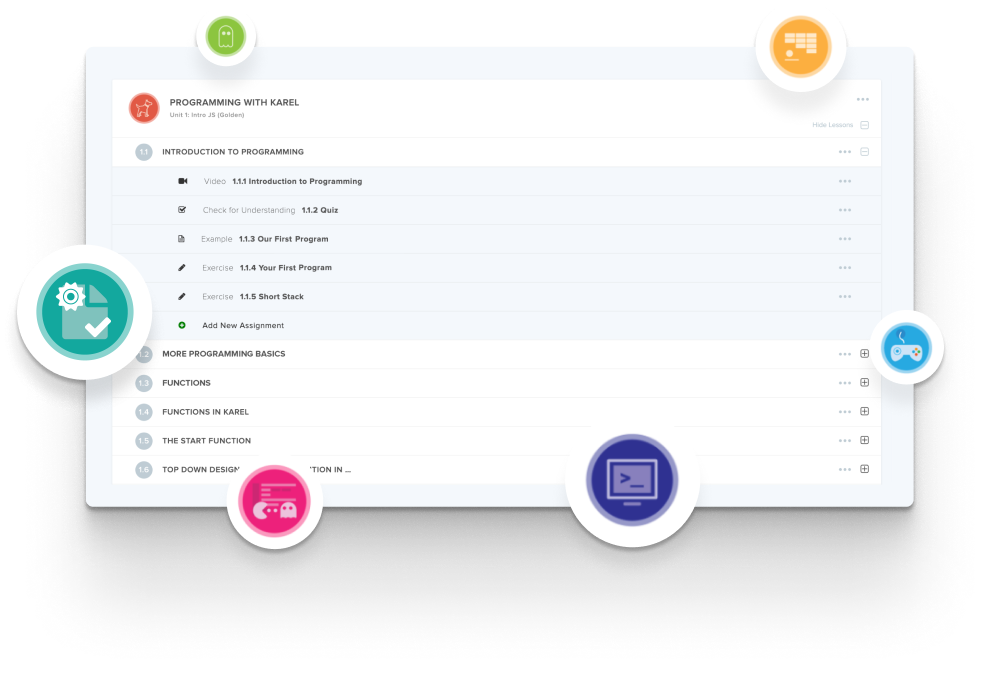
Create and organize Assignments in any CodeHS course that you're teaching. You can even add custom assignments to pre-existing CodeHS courses.
Learn MoreDidn't find what you were looking for? Here are a few links that might be useful to you.
You also might like
Quarter-long course that includes only the Arduino modules
Yeah-long course that integrates Arduino modules into Intro to Python modules
Semester-long course that integrates micro:bit modules into Intro to Programming with Karel the Dog
No. The description says the course provides the prerequisite information needed before students apply programming concepts to their Arduino device, so it starts from the beginning.
An Arduino device each, or shared between pairs, for the physical computing units. The JavaScript half runs in the browser.
About 175 contact hours, built to run across a full school year. It is the longest course in this family, because it contains a full introduction to computer science as well as the Arduino work.
This course pairs Arduino with Introduction to Computer Science in JavaScript; Introduction to Programming in Python with Arduino pairs it with the Python course. Both run 175 hours across a year and both end at the same Arduino work.
Length and starting point. Introduction to Physical Computing with Arduino is a 50-hour quarter that assumes students already know control structures, variables and functions. This course is a 175-hour year that teaches all of that first.