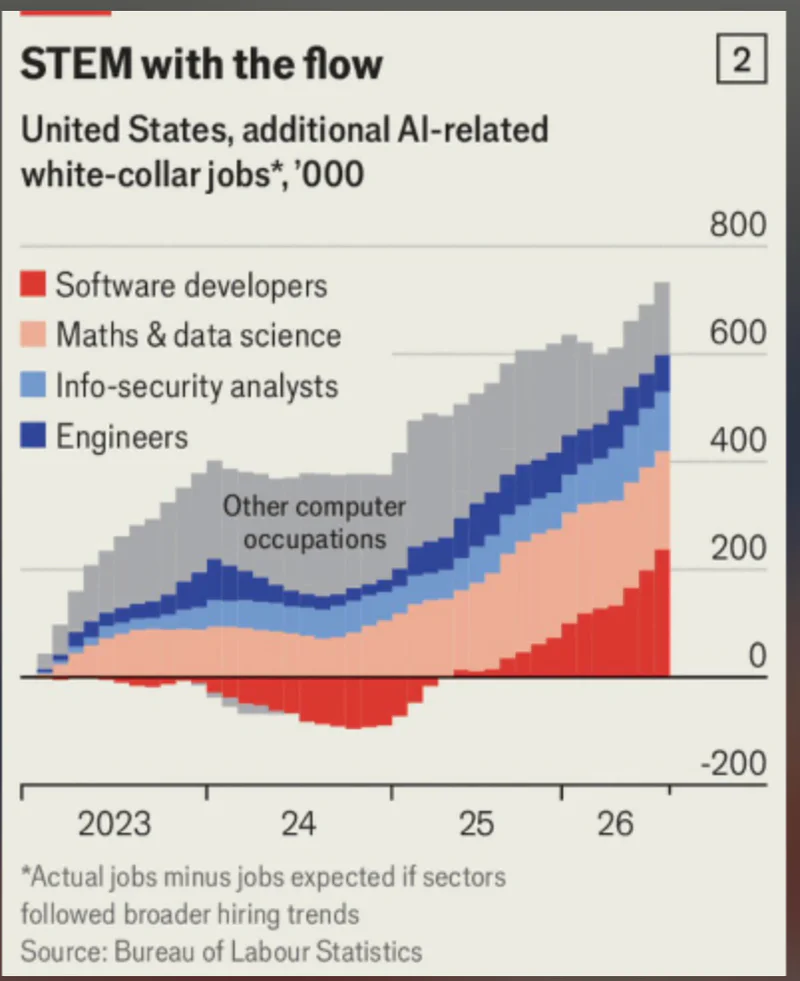
If AI can write code, should students still study computer science? Evidence from The Economist and the U.S. Bureau of Labor Statistics makes a strong case that they should.
In “The jobs apocalypse is postponed. An AI jobs boom is here,”The Economist reports that occupations closely connected to AI—including software developers, engineers, and data scientists—have added roughly 730,000 jobs above broader professional employment trends since 2022. That doesn’t mean AI created every one of those jobs, but it challenges the idea that these careers are disappearing.
The longer-term outlook points in the same direction. BLS projects computer and mathematical occupations to grow 7.3% between 2025 and 2035, more than twice the 3.5% growth expected across all occupations. It identifies expanding use of digital tools and AI as a major driver.
The projected growth includes:
10% for software developers.
About 35% for data scientists.
21% for information security analysts.
The reason is straightforward: adopting AI takes work. Organizations need people to build applications, connect data, evaluate results, and secure systems. As The Economist describes, companies are hiring people to develop AI models and adapt them to customers’ needs.
Some work will shrink. BLS expects employment in the narrower
computer programmer occupation to decline 7% as repetitive tasks become automated and some responsibilities shift to software developers. These projections describe a changing field, with opportunities that vary by role.
For schools, that strengthens the case for teaching programming fundamentals alongside AI literacy, data science, and cybersecurity. Students need to understand how technology works so they can question its outputs and build reliable solutions.
AI is changing what students will do with computer science—and giving them new reasons to learn it.